

What Does a Rubber Mixing Mill Do ?
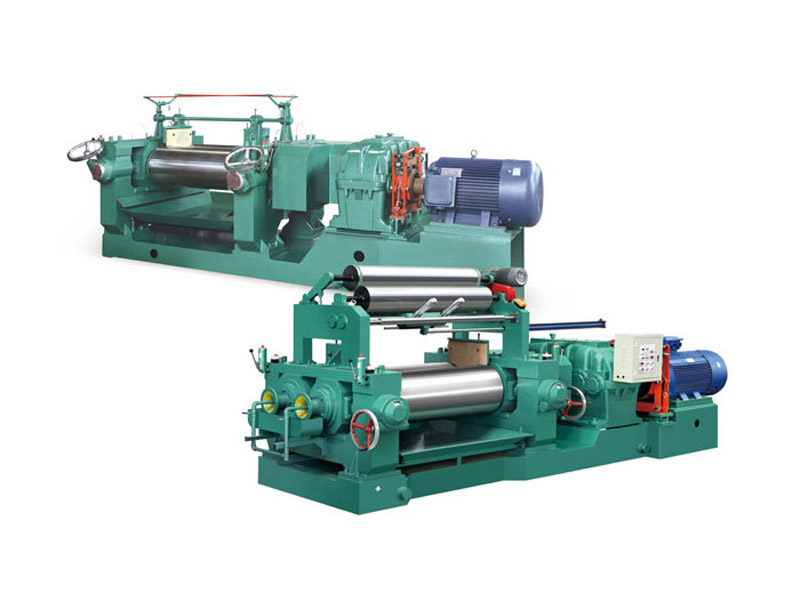
A rubber mixing mill, also called an open-type two-roll mill, is everyday equipment in rubber and plastic processing. Our XK series handles mastication, blending, warming, cracking, and final sheeting in one pass.
The two rolls spin at different speeds. The speed ratio pulls the compound through the nip, and that is where the real kneading happens. You feed the batch, it gets worked, and it leaves as a smooth sheet. In practice, the mill is where you plasticize raw rubber, blend in fillers and softeners, and, once mixing is done, add the vulcanizing agent and press the batch into sheet form.
The machine suits rubber and plastic lines alike, from a small workshop to a full production plant. Before any batch can move to molding or extruding, the compound has to be worked. This mill does that step reliably, batch after batch.
Why Does This Rubber Mixing Mill Use Chilled Cast Iron Rolls ?
The rolls are cast from vanadium-titanium alloy chilled cast iron. The surface stays hard and wears slowly, even when you run abrasive compounds. The inside is machined so the roll face heats evenly across its full length. That gives you a stable working temperature, which matters more than most buyers expect. Uneven heat means scorched edges or half-mixed batches.
This rubber mixing mill also ships with overload protection. If the load spikes, the machine protects its main parts instead of letting them bend or crack. An emergency brake sits within reach of the operator. Pull the safety bar and the mill stops on the spot. For a machine that runs all day, that combination is what keeps downtime low.
Is the Rubber Mixing Mill Easy to Run and Maintain?
Yes, and that is the part shops notice first. The drive train uses a hard-tooth-surface reducer. It runs compact and quiet, with high efficiency and a long service life. Self-aligning bearings on both rolls cut power draw and keep maintenance light.
The whole machine is mounted on one integral base. You bolt it down, wire it up, and it is ready for the first batch. No complicated foundation work before you start production. Most shops have it running within a day of delivery. Day-to-day upkeep is straightforward: keep the rolls clean, check the reducer oil, and the mill keeps going.
Which Rubber Mixing Mill Size Do You Need ?
We offer three standard models. The table keeps it simple.
| Model | Roll size (mm) | Main motor | Weight |
|---|---|---|---|
| XK560 | 550×1530 | 90 kW | 17,500 kg |
| XK450 | 450×1200 | 45 kW | 12,000 kg |
| XK400 | 400×1000 | 37 kW | 7,500 kg |
Front roll linear speed runs from 27.65 m/min on the XK560 down to 20.6 m/min on the XK400. Roll speed ratio is 1:1.27 to 1:1.29, and the reducer ratio sits between 47 and 47.5. All three models run on 6-pole AC motors.
Pick the rubber mixing mill that matches your batch size and plant layout. If you are not sure, send us your compound and daily output. We can point you to the right machine.
